

Consent management is a process that’s no longer just a legal checkbox. It’s a practical decision that affects a company’s SEO visibility, its accuracy with analytics, and its experimentation as a business.
According to TrustArc, the global CMP market was valued at approximately $400 million in 2023 and is projected to reach $2.5 billion by 2032. So it’s certainly a growing area of business that many are already leveraging for their companies.
For teams that are focused on sustainable growth, it’s imperative to utilize consent management platforms for efficiency, legal compliance, and long-lasting growth. In this guide, we’ll look at several consent management platforms that are trusted by marketers in 2026 and how they could benefit your business this year.
1. Usercentrics — Best for SEO, Analytics, and Experimentation-Driven Teams
Best for: Growth, SEO, and performance marketing teams
Company size: SMB to mid-market, scaling brands
Why it stands out: Granular control without sacrificing data quality
For many modern digital teams, SEO and growth teams need that granular user data to optimize conversion rates and search rankings. At the same time, they need to adhere to the GDPR/CCPA regulations and any other regulations in place that mandate strict user content.
If it’s not implemented correctly, then any compliant cooking banner will block analytics tracking, resulting in the collection of less data on platforms like GA4. That causes issues when it comes to marketing automation, A/B testing, and improving SEO efforts in general.

How SEO and growth teams typically use Usercentrics
Growth teams use CMPs like Usercentrics to manage several moving parts at once:
- Region-based consent rules using IP detection
- Tag firing control to prevent unauthorized scripts
- Analytics data modeling to reduce data loss
Usercentrics allows teams to ensure consent banners don’t block search engine crawling or degrade site performance. This helps maintain both search visibility and clean analytics data.
Why teams choose Usercentrics
Having a flexible, marketer-friendly CMP fits teams that are looking to balance compliance with performance. Usercentrics consistently appears among the best consent management platforms for teams that rely heavily on SEO, analytics, and experimentation.
For day-to-day SEO and analytics workflows, CMPs automate complex tasks like synchronizing user choices with tracking tags to prevent any manual bottlenecks.
This approach is particularly valuable for teams scaling across multi-domain and multi-country sites through centralized policy management.
Geo-specific adaptive banners ensure users see relevant consent requests, while marketers retain the ability to test, measure, and optimize without compromising compliance.
2. Osano — Best for Compliance-First and Regulated Industries
Best for: Financial services, healthcare, public sector
Company size: Mid-market to enterprise
Why it stands out: Legal certainty and audit readiness
There are some companies, like those in financial services, government/public sector, and healthcare, for example, where compliance, legal assurance, and risk management outweigh the need for frequency in SEO testing or analytics customization.
How compliance-first teams typically work
Compliance-first teams will operate by embedding their legal, regulatory, and privacy requirements directly into the foundations of the business operations. Legal and operations teams, therefore, hold authority over data collection, creating a compliance-by-design framework.
Osano supports this approach by translating complex privacy requirements into automated, scalable workflows.
Why teams choose Osano
Osano is one that’s chosen by these compliance-driven organizations for the ability to transform complex privacy requirements into automated, scalable workflows.
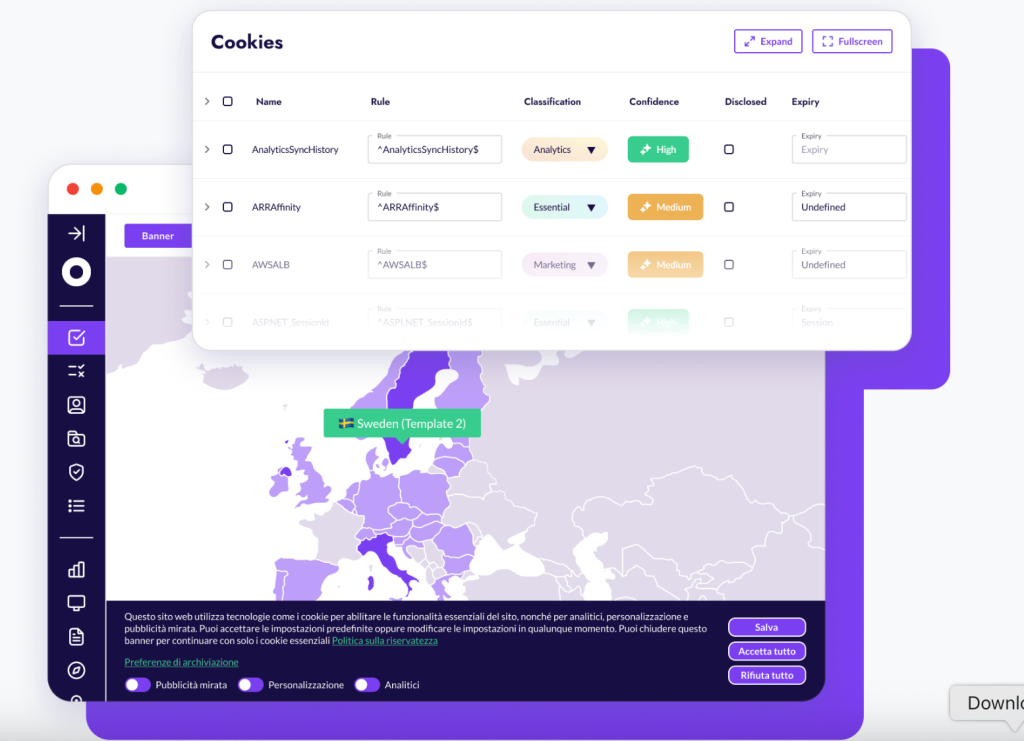
There’s the ease of setup for standard sites, where teams are able to implement Osano’s Cookie Consent, adding just a single line of code to their site’s <head>. It integrates with other CMS platforms like WordPress and offers rapid deployment.
The platform offers ongoing compliance monitoring, which includes:
- Real-time scanning
- Vendor risk tracking
- Legal updates
There’s also the ability for legal and marketing teams to collaborate by offering unified visibility of cookie activity and consent data.
Marketing teams are able to customize banner styles to help match brand aesthetics, and these teams also use visible consent data to optimize their campaigns for strategic growth.
There’s a suitability in this platform for many regulated industries due to its compliance guarantee and audit readiness, as well as its sector support that’s tailored to certain industries.
3. OneTrust — Best for Enterprise Governance and Global Operations
Best for: Large enterprises with multiple regions and brands
Company size: Enterprise
Why it stands out: Centralized governance at scale
Large organizations that have multiple brands, regions of operations, and internal stakeholders need a centralized consent management platform with strict governance across departments and regions.
How large teams typically use this platform
Platforms that have a strict governance offer a unified framework for global organizations and enterprises to collect, track, and enforce data permissions across all departments and geographic regions.
It creates a ‘single source of truth’ to ensure the user’s choice in one department or region is then instantly respected across the entire enterprise.
Why enterprises choose OneTrust
So why do enterprises trust OneTrust as a platform with strict governance? Scale and oversight matter most here, and many benefits make OneTrust a good option as a CMP.
OneTrust’s platform enables organizations to establish data governance and privacy programs through a unified system of record for all compliance activities.
The platform also enables effective collaboration amongst various departments, whether that’s marketing, legal, or security. Using a centralized system ensures teams are able to work together on compliance tasks without any friction, even as the company grows.
In relation to security and policy consistency, the F5 2025 State of Application Strategy Report found that 53% struggle with security consistency, and 47% surveyed struggle with policy consistency. Centralized management platforms and visibility, therefore, help to address these issues.
One Trust is designed to handle the vast and ever-changing landscape of global regulations. It helps companies navigate these complex regulatory environments by providing tools to quickly adapt to new requirements.
As a result, it maintains legal adherence across many different jurisdictions, which often causes a lot of headaches for enterprises globally.
With platforms like this one, it’s built for large organizations specifically. The platform is able to manage massive volumes of data, as well as high numbers of users and systems. Its scalable architecture is great to ensure the compliance program grows with the business.
4. Complianz — Best for Small Sites and WordPress-Focused Teams
Best for: Small businesses, single-site owners, agencies
Company size: Solo to small teams
Why it stands out: Fast setup and affordability
Smaller teams might require basic compliance without the advanced customization or long-term scaling offered by other platforms on this list.
Common scenarios where this is required would be for those businesses that have low traffic and offer minimum viable products. If you’re looking for a fast and no-fuss setup that meets basic legal requirements like GDPR or CCPA without the need for deep analytics and handling, then a basic model is often the best suited.
How small teams typically use these tools
For teams that don’t need such enterprise-level scaling, lightweight consent management platforms provide a streamlined path for compliance. Many basic CMPs will have quick deployment, with implementation taking just minutes.
There’s minimal maintenance required with platforms of this size, and you’ll typically find a hub of useful features still available.
From automated cooking scanning to automated policy law updates, too. With a smaller platform, these simplified tools offer single-site management.
Often designed with a centralized, user-friendly dashboard that manages a single domain. It reduces the tech stack sprawl by giving businesses the necessary features only.
Why teams choose lighter platforms like Complianz
Lighter platforms like Complianz deliver a native and automated experience over the complexity of an enterprise-level customization.
These tools make the most sense for single-site owners, agencies that need to move quickly, and WordPress-focused developers. Complianz is a platform that offers a robust free version for basic GDPR compliance.

With premium tiers that start from around $59 per year, this platform is much more affordable than the enterprise alternatives available.
There’s efficiency in the setup of this consent management platform. Integration is often as simple as installing a WordPress plugin. It allows sites to become compliant within minutes and without the need for custom coding.
Even at the lighter level of CMPs, it provides essential features like proof of consent logs and script blogging. Regarding legal compliance, Complianz covers major regulations like CCPA, GDPR, and more, and integrates with Google Consent Mode v2, ensuring standard legal requirements are met.
Why the CMP choice directly affects SEO performance and data quality
Consent management platforms help to influence discoverability, experimentation, and reporting accuracy. The best choice will depend on the workflow needs of the company and the size, so it’s good to explore which one of the options mentioned above would be your best match.
CMPs are crucial for companies to remain compliant with data collection and usage, as well as adhere to legal requirements.