

Manual B2B lead generation looks cheap until the team counts hours. Keyword research, content briefs, article production, outreach, follow-ups, negotiations, and reporting all draw from the same budget: skilled time.
The source research shows a clear pattern. Manual work still creates value, but teams should use it where judgment matters. Software should handle repeatable research, checks, tracking, and reporting.
This article turns the research into an operating guide for SEO specialists, content leads, link builders, and B2B growth teams.
It compares the three workflows, shows the hidden costs, and gives cost models teams can use before they hire, buy tools, or scale outreach.
Source base: the article uses the attached research document. That document surveyed 2024-2026 data from SEO tool vendors, agencies, outreach studies, and content marketing benchmarks.
It cites Ahrefs, Semrush, Moz, Orbit Media, SEOClarity, BuzzStream, HubSpot, BrandClickX, LinkBuilder.io, Hennessey Digital, Belkins, and Digital Elevator.
What manual B2B lead generation includes
Manual B2B lead generation means a team uses human work to attract, qualify, and convert leads through organic search, content, and links.
In this context, the team does not only run sales prospecting. It builds pages, earns traffic, secures links, and turns search demand into pipeline.
The cost hides because finance teams see separate line items. Payroll sits in one place. Tools sit in another. Failed outreach rarely appears as a cost.
Rework often looks like normal SEO maintenance. A better model counts the workflow from the first keyword export to the final lead.
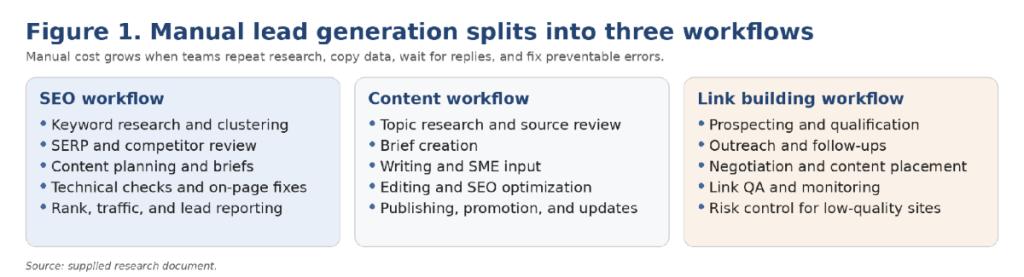
The workflows overlap, but each loses money in a different place:
- SEO loses time in keyword exports, clustering, SERP review, technical checks, and reporting loops.
- Content loses time in research, briefs, expert review, editing, optimization, publishing, promotion, and updates.
- Link building loses time in prospecting, qualification, outreach, follow-ups, negotiation, placement, and link monitoring.
The hidden cost baseline
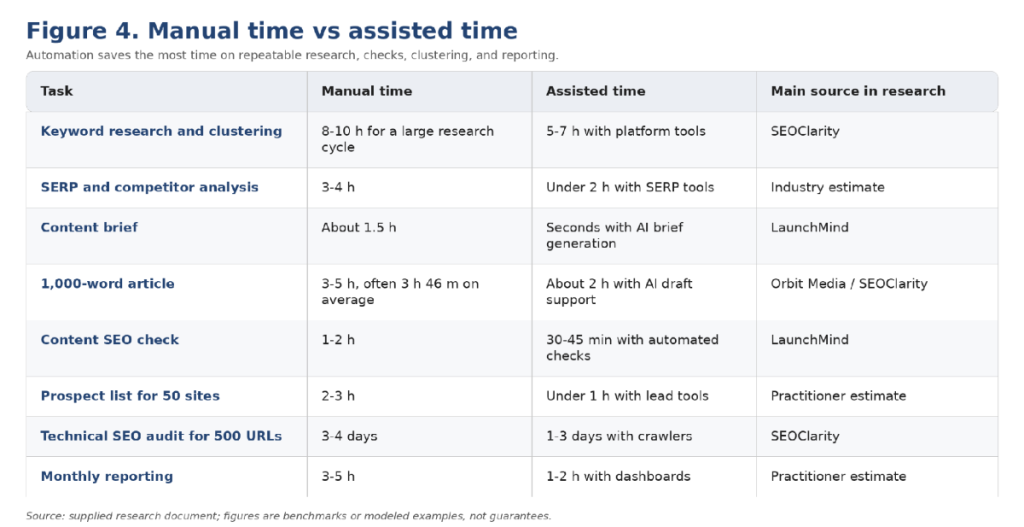
The source research gives useful benchmarks. A 1,000-word SEO article can take about 3 hours and 46 minutes to write on average.
At a loaded US content-writer cost, that equals about $134 in labor before editing, optimization, publishing, promotion, or management. SEOClarity benchmarks place SEO-optimized content at 4-6 hours per piece.
Manual link building creates a larger spread. A single placement can require 5-15 hours when the team counts prospecting, qualification, outreach, follow-ups, content, negotiation, and QA.
At $40-75 per hour for an outreach specialist, a $400 link no longer looks high. It often reflects the labor behind the placement.
Outreach failure compounds the cost. The research cites outreach benchmarks of 40-60% open rates and 15-30% reply rates. Most emails do not produce a link. Teams pay for the unsuccessful work too.
SEO workflow: high leverage, slow manual loops
SEO work creates compounding returns when the team chooses the right pages and fixes the right constraints. Manual SEO becomes expensive when specialists spend their time moving data instead of making decisions.
A manual keyword research cycle can take 8-10 hours. That includes identifying high-value keywords, checking intent, grouping terms, reading SERPs, and reviewing competitors.
A technical audit can take 2-3 days at the start of a project. Monthly reporting can add 3-5 hours when the team builds reports by hand.
Manual SEO still matters in four tasks:
- Search intent judgment. Tools can cluster terms, but the SEO lead must decide which page should own the intent.
- SERP interpretation. A tool can show competitors. A specialist must read why Google ranks them.
- Prioritization. A crawler can list issues. A human must decide which fixes affect revenue pages first.
- Business context. A dashboard can show traffic. A growth lead must tie the traffic to leads and pipeline.
Automate exports, clustering, crawls, duplicate checks, schema checks, rank pulls, and dashboards. Keep the page strategy manual.
Content workflow: the article cost starts before writing
Content teams often undercount the cost because they price only the writer. A useful B2B article also needs a brief, source review, expert input, editing, SEO checks, publishing, promotion, and updates. The research shows why cheap article pricing can mislead teams.
At a loaded writer cost near $74,018 per year, a 3.75-hour article costs about $134 in writing labor. That number excludes editor time, SME review, content optimization tools, project management, and promotion.
A freelancer at $50 per hour who spends five hours on a piece costs about $250 before editing. Expert or outcome-driven posts can cost much more.
Manual content work creates value when the writer explains a real process, compares choices, validates claims, and removes weak statements.
It wastes budget when a team writes from a generic outline, repeats competitor sections, or publishes without refresh logic.
A content lead should calculate article cost like this:
- Article cost = research time + brief time + writing time + SME review + editing + SEO check + publishing + promotion + refresh time.
- Article CPL = article cost / (organic visits x lead conversion rate).
- Refresh cost = update time x loaded hourly rate + any design, dev, or SME review time.
Link building workflow: low response rates turn hours into sunk cost
Manual link building looks simple when a team counts only the final placement. The real workflow has more steps: prospecting, domain qualification, contact finding, email writing, follow-ups, negotiation, content creation, anchor review, publication checks, and link monitoring.
Before a team buys another outreach app, it should map prospecting, qualification, outreach, follow-ups, and monitoring against a clear list of link building tools.
The goal is not to automate relationship building. The goal is to stop analysts from copying domains, emails, metrics, and statuses by hand.
The team should keep these link-building tasks manual: pitch angle, site relevance checks, anchor decisions, negotiation, and final placement QA.
The team should automate email discovery, metric collection, duplicate checks, sequence tracking, status changes, and link monitoring.
A link builder should price outreach with failed attempts included. If 200 emails produce 40-60% opens and 15-30% replies, the team still pays for every prospect that never replies.
Follow-ups can increase response volume, but they also add labor. A stronger model tracks cost per qualified prospect, cost per reply, cost per accepted placement, and cost per live link.
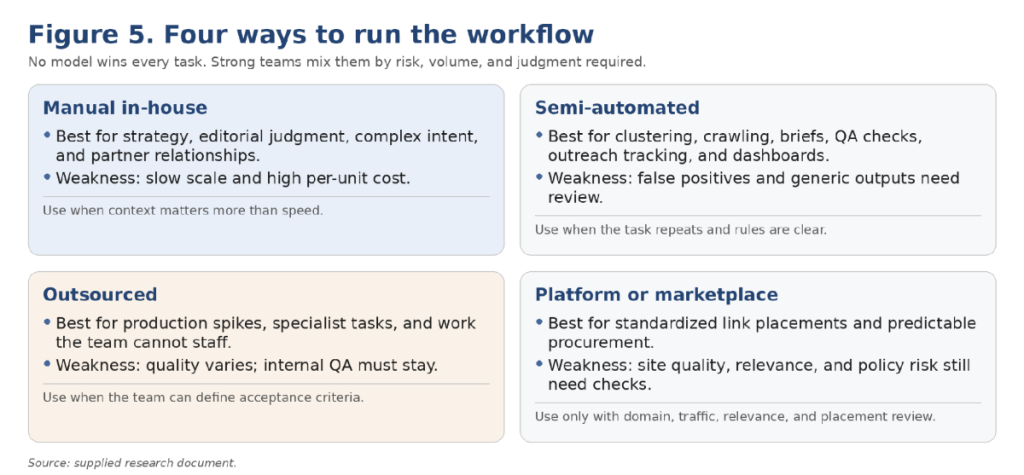
Manual, automated, outsourced, and platform workflows compared
Teams should not choose one operating model for every task. Manual work protects quality. Automation removes repeat work. Agencies add capacity. Platforms can simplify procurement. Each model also creates risk.
A practical hybrid model works like this:
- The SEO lead owns search intent, prioritization, page strategy, and quality rules.
- Tools collect data, cluster terms, crawl pages, monitor rankings, and track links.
- Writers and editors use briefs, but they verify claims and rewrite weak sections.
- Link builders use outreach software, but they personalize pitches and review every placement.
- Managers track hours, unit costs, response rates, live links, conversion rate, and CPL.
Cost models teams can use before they scale
A team should model cost before it scales manual production. Volume hides waste. More articles, more emails, and more links do not improve ROI if each unit costs too much or converts poorly.
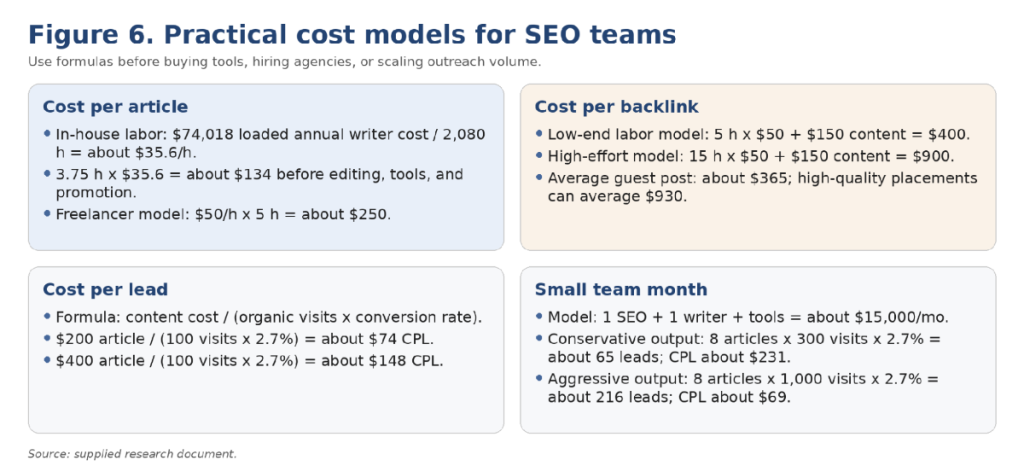
The monthly team model needs a sensitivity range. A small B2B SEO team with one SEO specialist, one content writer, and core tools can cost about $15,000 per month.
If that team publishes eight articles and each article brings 300 organic visits, then 2.7% conversion produces about 65 leads.
CPL lands near $231 before link-referral effects. If each article brings 1,000 visits, the same conversion rate produces about 216 leads and CPL lands near $69. The output target changes the economics.
This model forces a better question. The question is not “Can we publish more?” The question is “Can each unit earn enough qualified traffic or authority to justify its labor cost?”
Bottlenecks and risks that teams undercount
Manual workflows fail when teams treat every delay as normal work. The source research points to seven hidden cost factors: labor-heavy research, failed outreach, follow-up delays, quality control, rework, management overhead, and compliance risk.
Three risks deserve extra attention.
First, outreach volume can damage quality. Templated pitches reduce relevance. Low-effort content weakens acceptance rates and can place links on poor pages.
Second, content decay doubles cost. A page that uses outdated data must be researched, edited, checked, and republished. Teams should schedule refreshes for pages that target revenue keywords.
Third, link-risk control still needs human review. Google has devalued scaled low-quality link patterns. A team should check relevance, traffic, page quality, anchor context, placement type, and link status. Software can flag issues. A specialist must decide whether the placement is worth the risk.
Operating rules for SEO teams
The safest rule: automate repeatable work, not judgment. The source research shows large time savings in briefs, SEO checks, keyword research, crawls, and dashboards. Those gains matter because they return hours to strategy, editorial review, and relationship work.
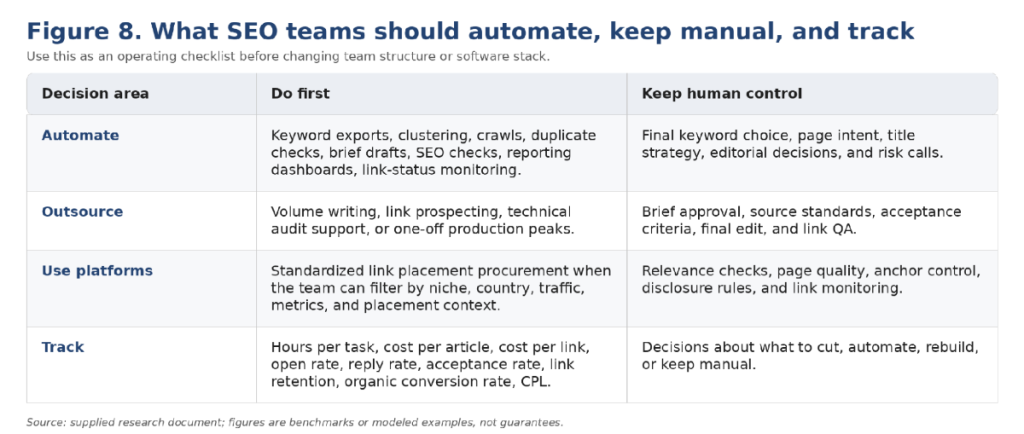
What to automate first
- Keyword exports, clustering, and intent grouping drafts.
- Technical crawling and recurring site checks.
- Content brief drafts and on-page optimization checks.
- Outreach CRM tracking, follow-up scheduling, and duplicate detection.
- Link monitoring, rank tracking, traffic dashboards, and CPL reporting.
What to keep manual
- Final keyword targeting and page mapping.
- SERP interpretation and content angle.
- Expert review and final edit.
- Outreach pitch quality and relationship handling.
- Placement approval, anchor review, and risk decisions.
When to outsource or use platforms
Outsource when the team lacks capacity or specialist skill, but can define clear acceptance criteria.
Use platforms when the workflow is standardized and the team can filter by niche, geography, language, traffic, authority metrics, placement context, and risk. Do not outsource strategy, QA, or final approval without internal ownership.
Metrics to track every month
- Hours per keyword cluster, article, audit, outreach batch, live link, and report.
- Cost per article, cost per accepted pitch, cost per live link, and cost per lead.
- Open rate, reply rate, acceptance rate, publication rate, and link retention.
- Organic conversion rate, assisted conversions, CPL, and pipeline value from organic leads.
- Rework rate: articles refreshed, links replaced, briefs rewritten, and technical fixes reopened.
Final takeaway
Manual B2B lead generation works when specialists use their time for judgment: intent, strategy, source quality, editorial standards, and relationships.
It wastes budget when skilled people copy data, rebuild reports, chase weak prospects, and fix mistakes that tools could catch earlier.
The team should price every workflow by unit. Count hours, rates, tools, failed attempts, rework, and risk. Then move repeatable work into software, outsource only with clear standards, and keep human control where quality affects rankings, trust, and revenue.
Source note
The article is based on the supplied research document. The research cites 2024-2026 benchmarks from Orbit Media, SEOClarity, BuzzStream, OutreachZ, BrandClickX, LinkBuilder.io, Hennessey Digital, HubSpot, Belkins, Digital Elevator, Ahrefs, Semrush, Moz, and related industry pricing pages. Numeric benchmarks in this article reflect those cited sources or modeled calculations derived from them.